
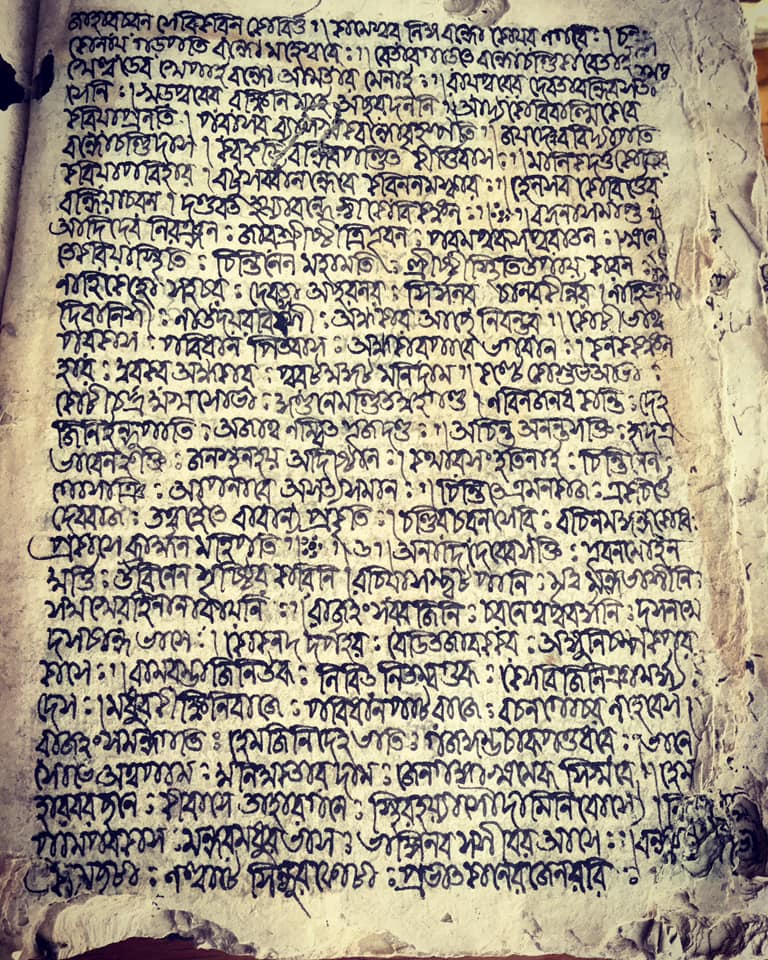
Kailasheshwar Basu was a solicitor for the Maharaja of Natore. He had followed his father into the trade, worked closely with the English East India Company and lived comfortably in the family home in a small village in Midnapore.
But in his spare time, Kailasheshwar was a poet. Versatile in Bengali, English, Persian and Sanskrit, Kailasheshwar wrote Kalimangal in 1848. Although printing had arrived and was increasingly cheaper and more popular, Kailasheshwar wrote and copied the entire Kalimangal by hand, perhaps ‘as an act of piety’*. In 1885 he died, leaving a very comfortable estate in Pingla. The estate grew into a zamindari nurturing five generations of artists, entrepreneurs, physicians, educationists and adventurers. The zamindari was eventually abolished on 15 April, 1955. The day was Poila Baishakh and the announcement was made from the Durbar Hall at Murshidabad, which Kailasheshwar had known all too well as a young man when arguing cases for the Natore estate at the Nawab’s court.
Today, Kailasheshwar’s Kalimangal lives in a small village in the South West of England under a row of chalk hills with his great, great grandson, his wife and their twelve fish.
* Kailasheshwar’s Kalimangal was referenced in the recently published Print and Publishing in Colonial Bengal, by Tapti Roy.
Wiltshire, March 2019
 Swagata Ghosh